

Works in the Collection by Other Artists:
Aldo Tambellini :: Sonia Landy Sheridan :: Ed Emschwiller :: Sue Hirtzel :: David Becker
“I believe this era demands an understanding of the “instantaneous”; the ability to communicate at the speed of light; the development of organic concepts to bring man closer to the forces of nature—a new orientation of the senses. The technological world is merging with our daily life. The future demands a realistic approach based on energy demanding new solutions.” —Aldo Tambellini
The ART of IS :: Works by Ilene Schuster
For prices, information or to make an appointment to view the Collection, Contact Hudson EState Sales.
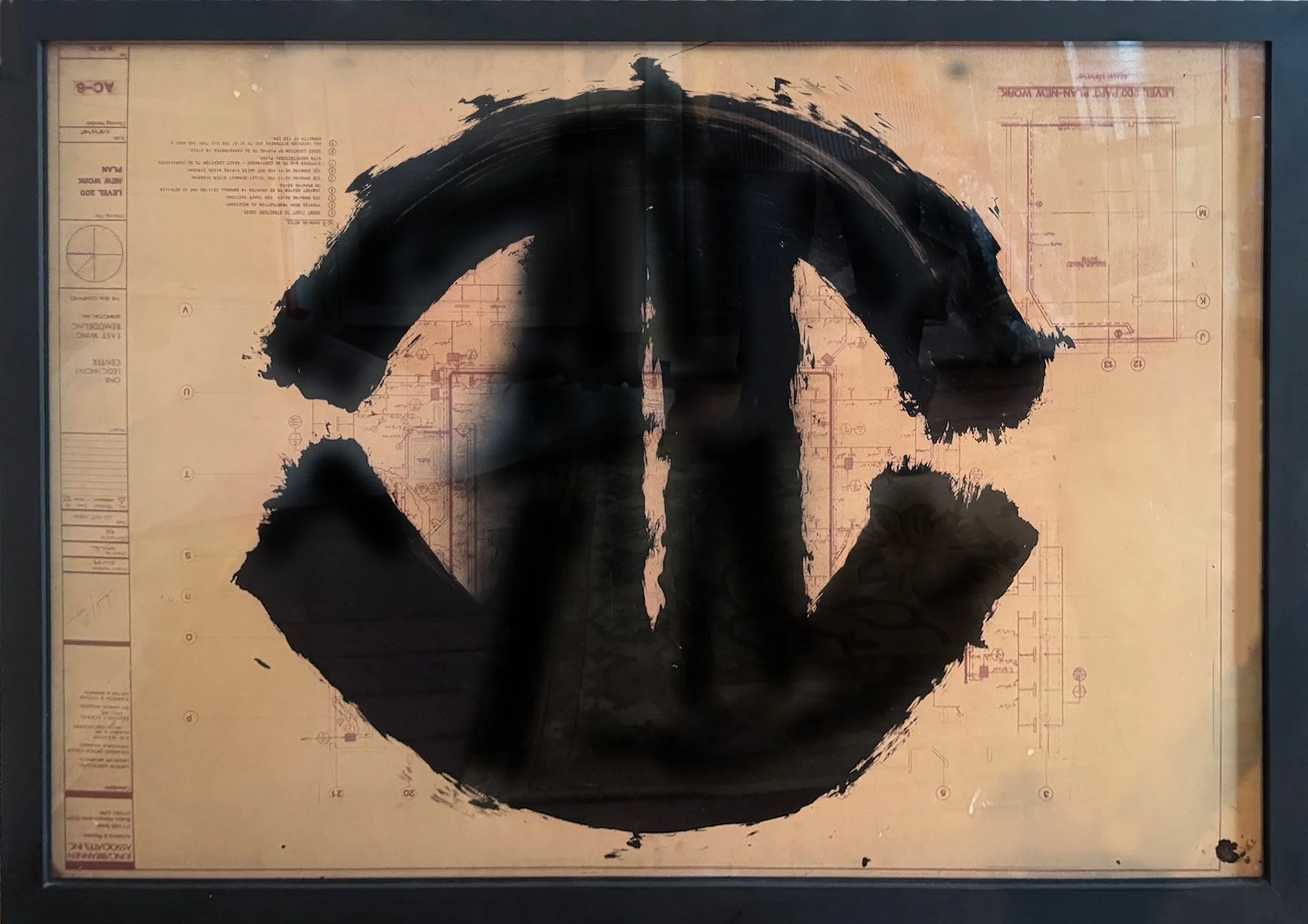
AC-6, Aldo Tambellini (c. 2010) Acrylic, airbrush on architectural paper, framed with glass, 45” x 33”, price on request
ALDO TAMBELLINI :: ARTIST STATEMENT
“‘Black’ is the expansion of consciousness in all directions,” he wrote in a 1967 manifesto, “Black Is the Awareness of a New Reality,” republished 42 years later in a catalog for his retrospective at the Pierre Menard Gallery in Cambridge, Mass. “I see ‘Black’ very clearly as the beginning of all things; and in the beginning it was ‘Black’ before the beginning. There was ‘Black’ before there was light in the whole universe. There is ‘Black’ inside the womb before the child is born. ‘Black’ is not the opposite of white; it is a state of being. We come from this womb. We come from this planet enveloped by ‘Black.’”
“I believe this era demands an understanding of the “instantaneous”; the ability to communicate at the speed of light; the development of organic concepts to bring man closer to the forces of nature—a new orientation of the senses. The technological world is merging with our daily life. The future demands a realistic approach based on energy demanding new solutions.”
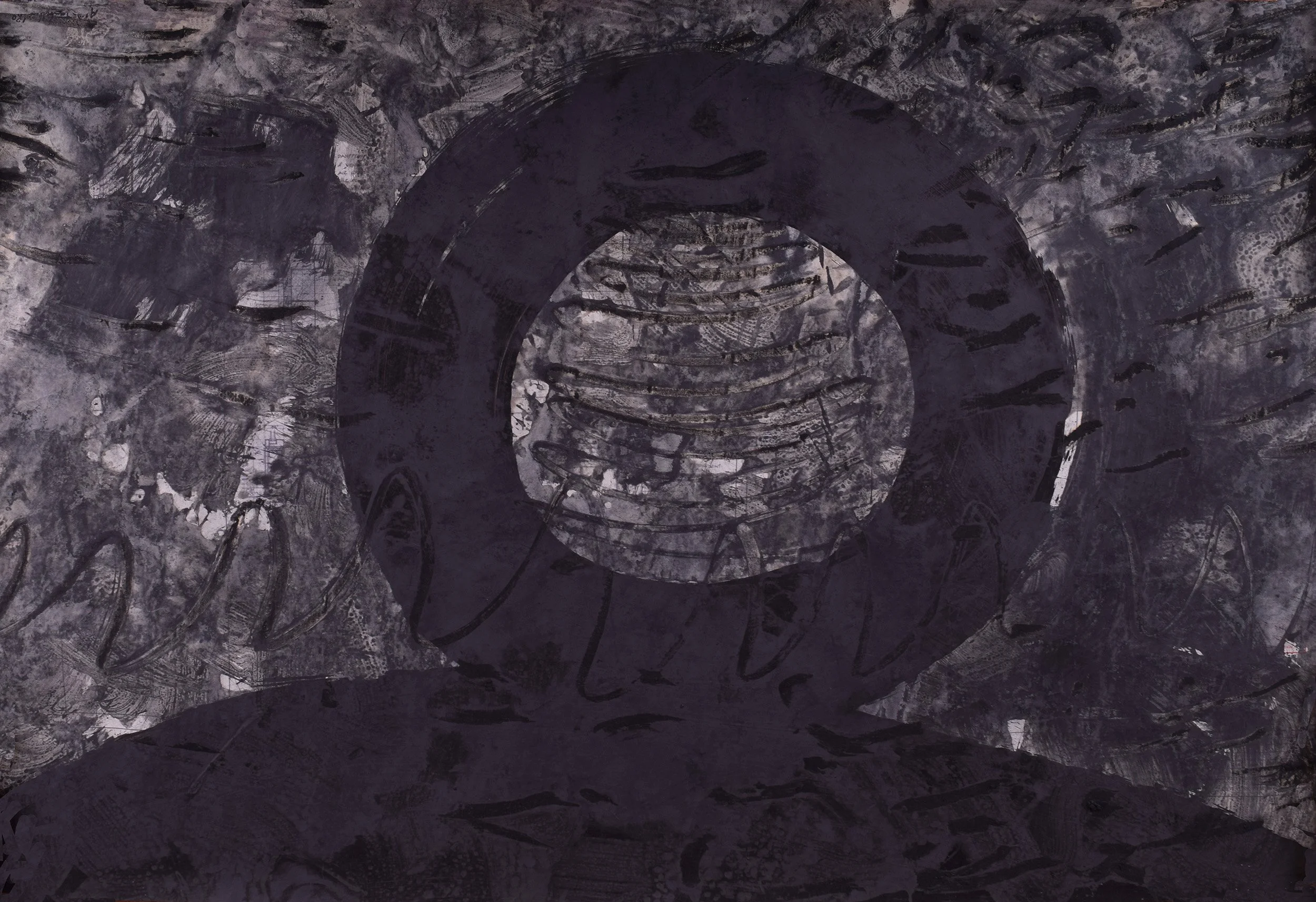
Black Energy Suspended Series,Aldo Tambellini (c. 1989) Acrylic on bleached architectural paper 42” x 30”, unsigned, price on request
Aldo Tambellini
From the Estate of Ilene Schuster
Aldo Tambellini (1930-2020) was an astonishingly diverse multi-media artist, poet and profoundly influential figure of 20th century art. A cult-like visionary with a predilection for the color black, he began his career as a painter, and later as a sculptor, using detrittus from demolished buildings. In the early 1960’s, he opened “The Gate” an underground movie theater that served as a location for his elaborate multi-media performance art pieces, and established Tambellini as a key figure in the Lower East side avant-garde arts scene.
Tambellini built upon his early collaborative performances with “Black Zero” (1965) and Moondial (1966), shown at the Brooklyn Academy of Music and the Tate Modern. These live performances consisted of a barrage of projected imagery. live music and electronic media that was part improvisation, part video, part soundstage, part political commentary, and part theater of the absurd. (Tambellini exhibited Black Zero three decades later in NYC at the Performa Biennal, the Astor Playhouse and the Chelsea Museum, among others.)
In the 1970s, Tambellini was a major figure in the counter-culture movement, devising new methods of creating and displaying non-tradtional art. He exhibited in first museum show of television as an art form at Brandeis University (1970) and the first video art show at The Whitney Museum (1971).Tambellini was a fellow at the Center for Advanced Visual Studies at MIT, working to advance telecommunications among a network of artists, The Communicationsphere, presaging the internet. Always pushing the boundaries of electronic media, he continued to engage with emerging technologies, shoot experimental films, exhibit video works and documentaries, despite his stated disdain for the elitism of the art world. Tambellini held international major shows and exhibitions, including a one-man show at James Cohen Gallery, a Retrospective at the Tate Modern and the Venice Biennale. The Aldo Tambellini film collection was donated to the The Harvard Film Archive by the artist. His work continues be exhibited internationally, a testament to his influence on subsequent generations of multi-media artists.
Sonia Landy Sheridan
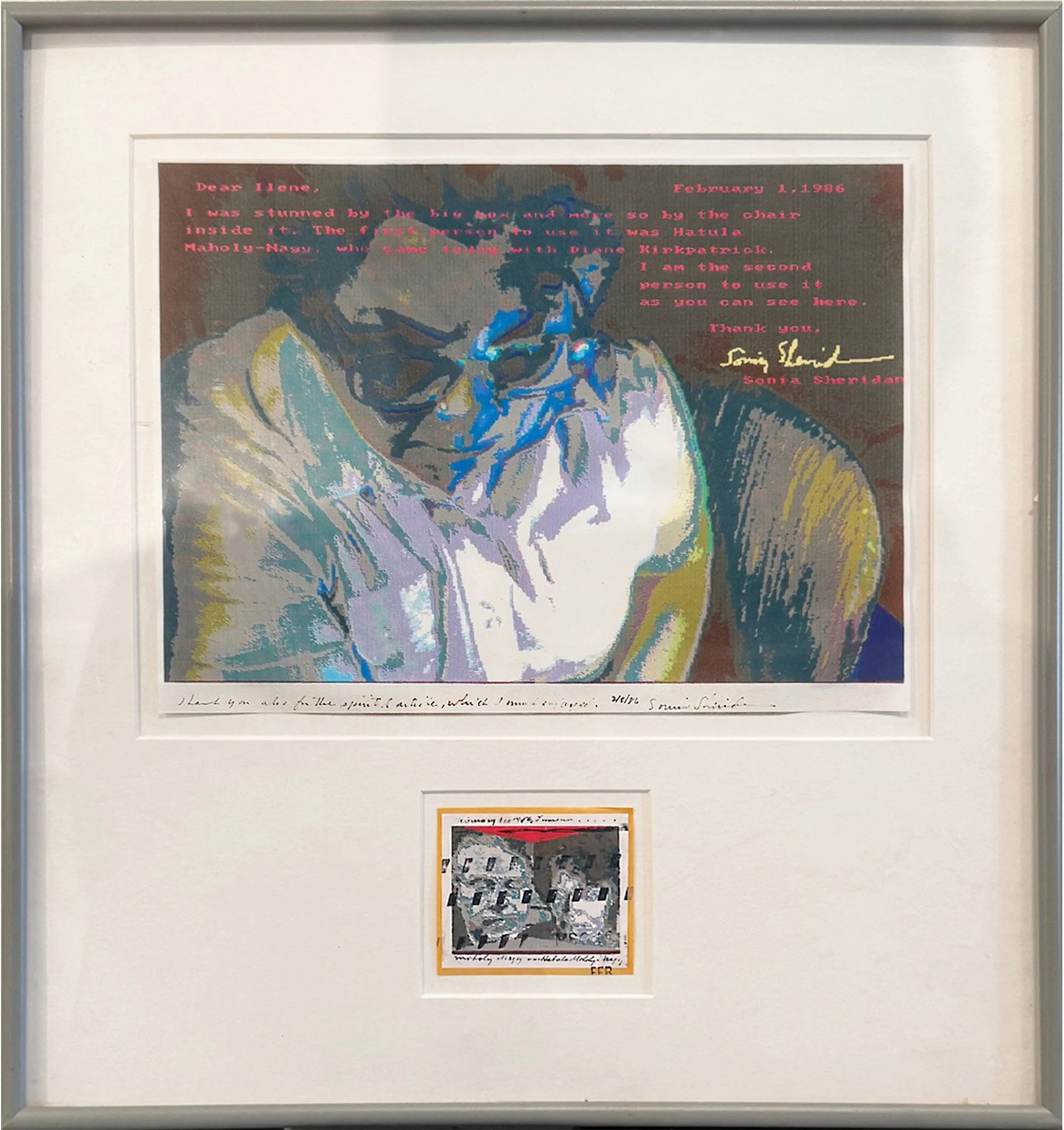
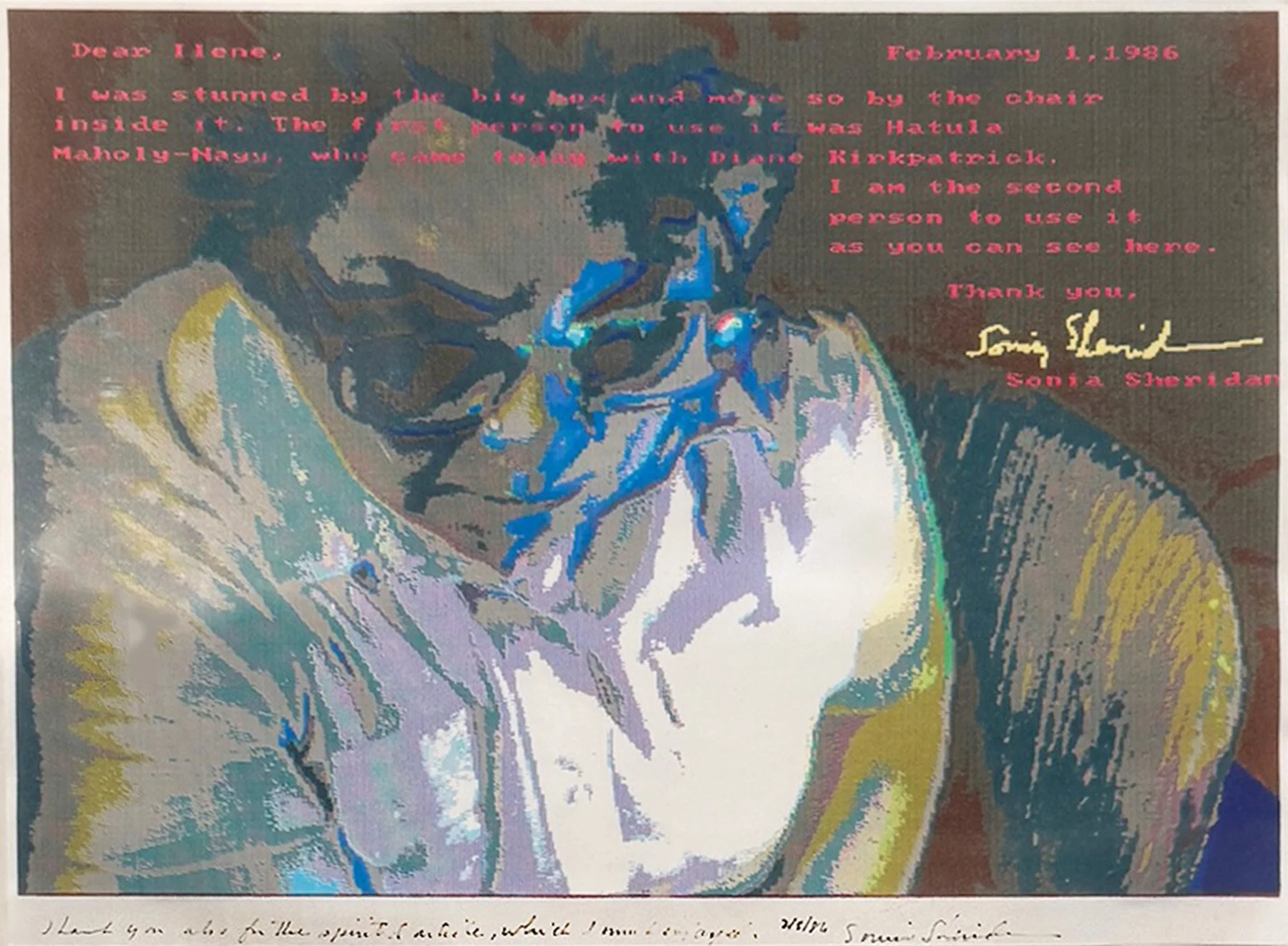
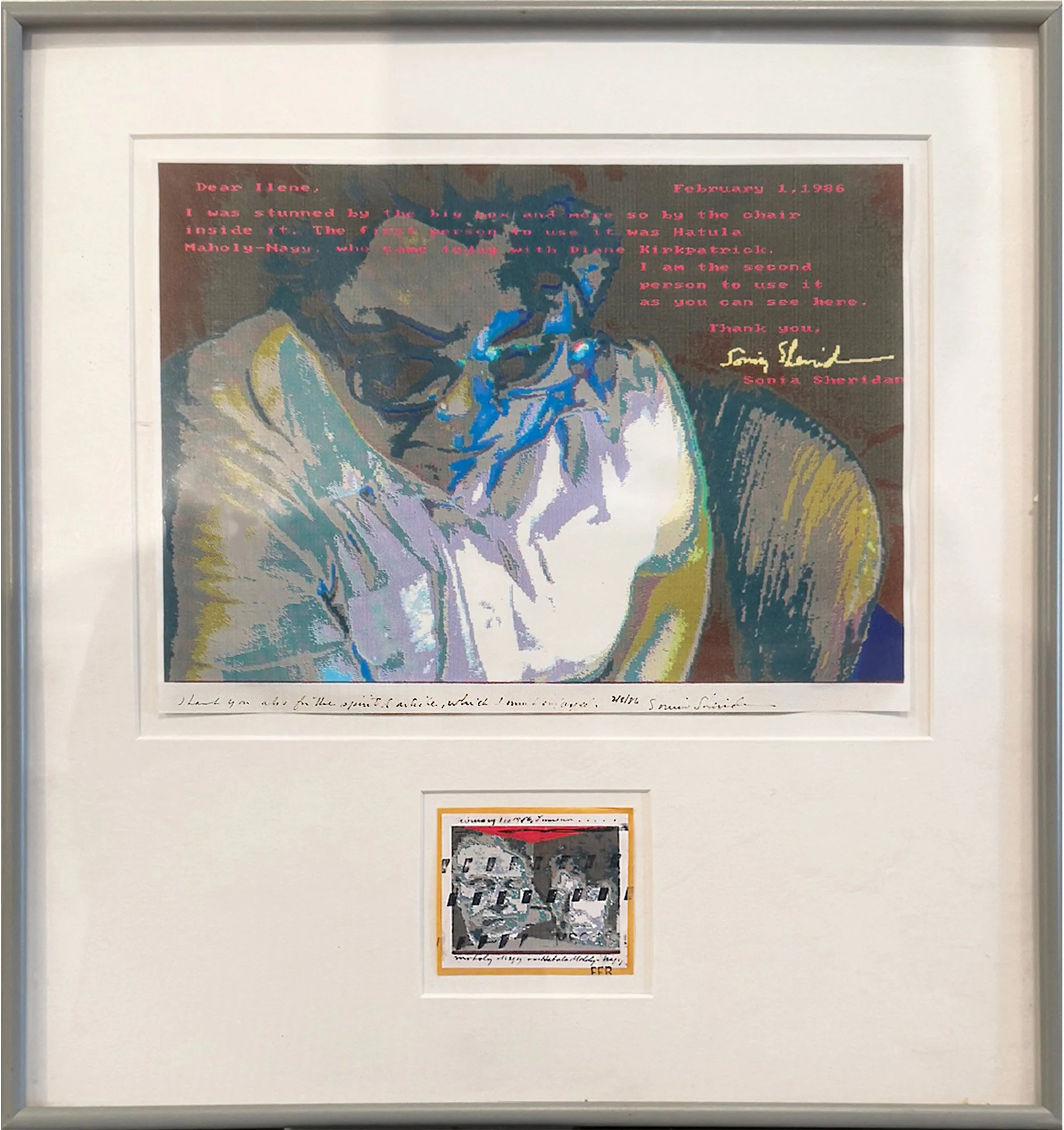
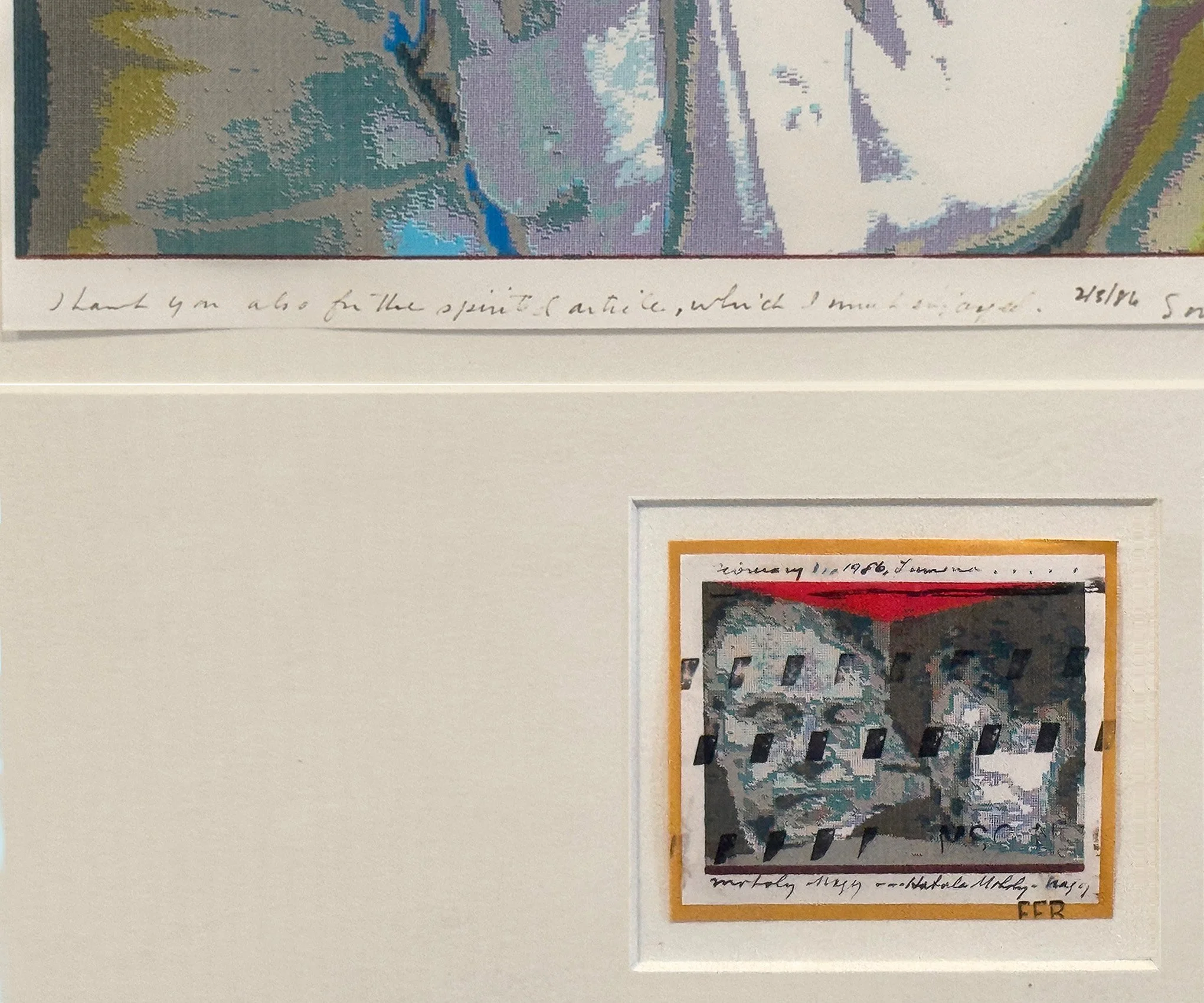
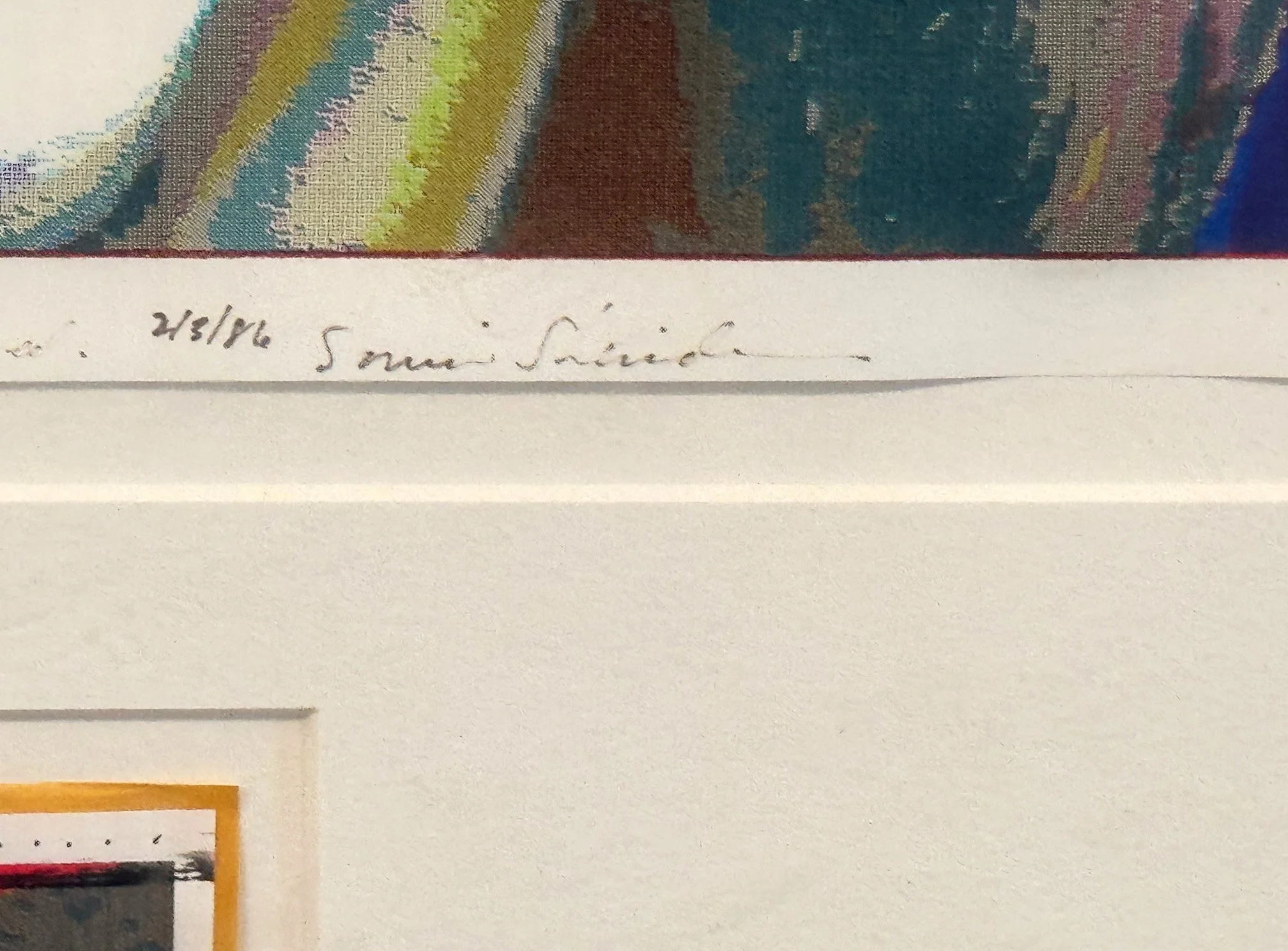
“I thank you also for the spirit of the article which I most enjoyed” Sonia Landy Sheridan (C. 1986)
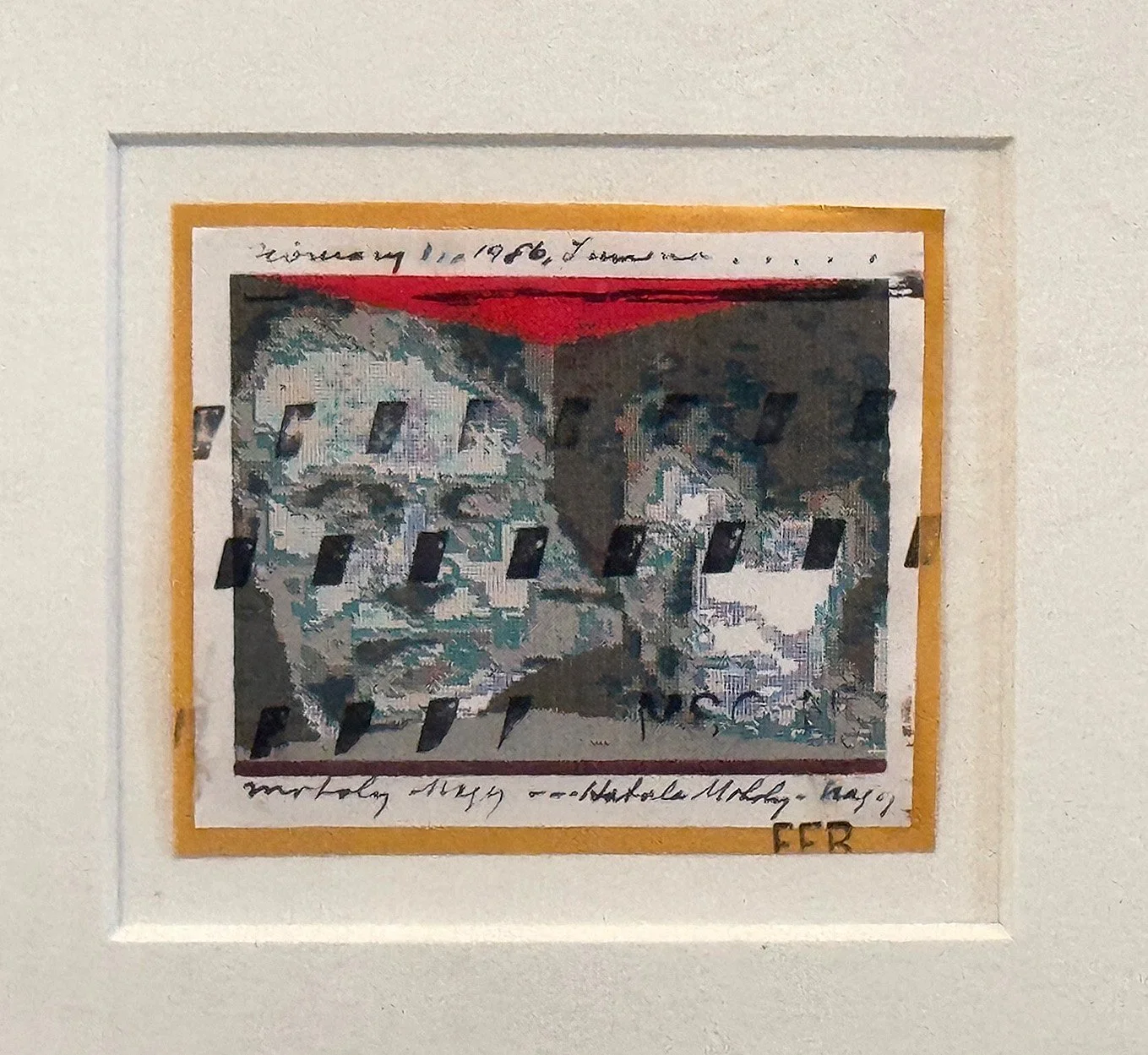
Digital prints: 16 x 17 framed overall, Larger print: 11 x 8.50 visible, Inset print: 3” x 2.50”, price on request
From the Estate of Ilene Schuster
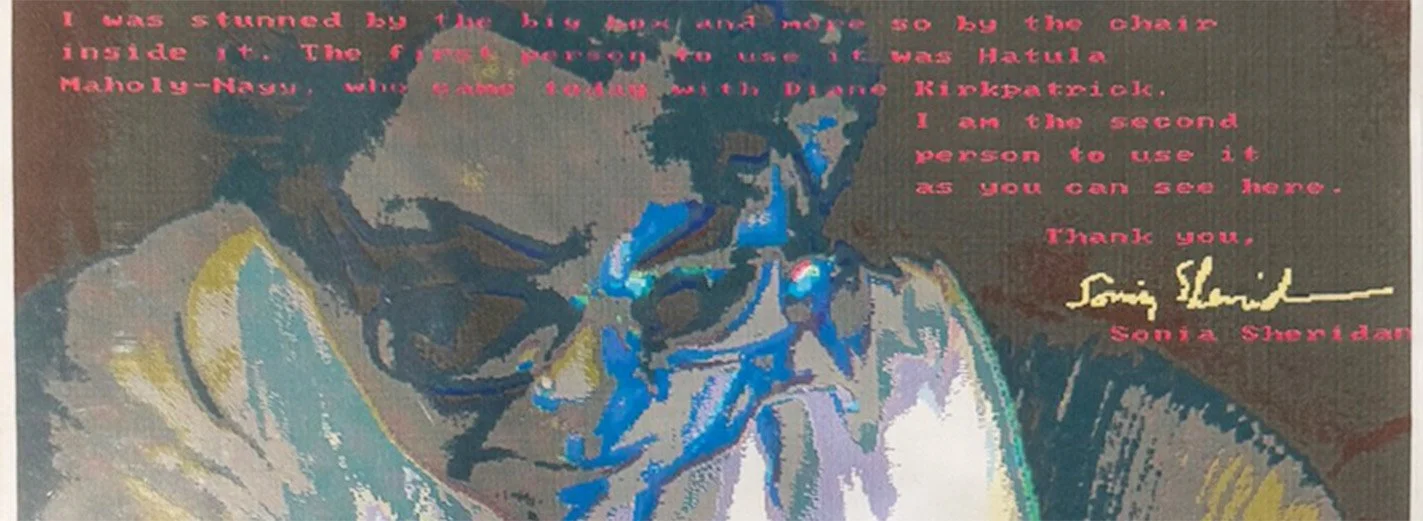
Personalized correspondence from Sonia Sheridan to Ilene Schuster. Two digital prints are combined in one frame, matted and framed. The larger of the 2 prints (11” x 8.5”) features the following text:
February 1, 1986
Dear Ilene, I was stunned by the big box and more so by the chair inside it. The first person to use it was Hatula Maholy-Nagy [sic] (1) who came today with Diane Kirkpatrick (2). I am the second person to use it as you can see here (3).
Thank you, (signature) Sonia Sheridan.
Handwritten note below the larger image reads: Thank you also for the spirited article, which I much enjoyed. 2/8/86 Sonia Sheridan (signature).
Inset print, 3” x 2.5” features digital images of 2 portraits, above which is inscribed: February 6, 1986, Lumina, and Below: Moholy-Nagy andHattula Moholy-Nagy. The Inset appears to have been cut from an envelope, and bears marks of postal cancellation.
Sonia Landy Sheridan (1925-2021) was known as a visual artist, researcher and pioneer in new media throughout the world. She founded the “Generative Systems” program in 1970 while teaching at the School of the Art Institute of Chicago. She encouraged students to explore emerging digital technologies and the relationship between art and science. As an artist, she repurposed early electronic communication and office machines, embracing the unexpected results of making art with an unpredictable new medium. Sheridan’s work was included in the first major museum exhibit of computer-assisted art at the Jewish Museum in New York Her interdisciplinary approach led to collaborations with 3M’s first color copier and innovations in computer graphic systems. Sonia’s received numerous awards and distinctions, among them, a Guggenheim Fellowship and three National Endowment for the Arts awards. Her work is in the permanent collections of Art Institute of Chicago and the San Francisco Museum of Modern Art.
Notes:
(1)Hattula Moholy-Nagy (1933-2024) was an anthropologist, artist, and the daughter of László Moholy-Nagy, the renown photographer, painter, conceptual artist and Bauhaus instructor.
(2)Diane Kirkpatrick (1933-2023) was an artist, art historian, and an early adopter of technological media, recognizing the potential of computer technologies for research, teaching, and exhibiting.
(3)Ilene Schuster, Sonia Sheridan, Hattula Moholy-Nagy and Diane Kirkpatrick had careers associated with the University of Michigan, beginning in the late 1960’s.
Ed Emschwiller
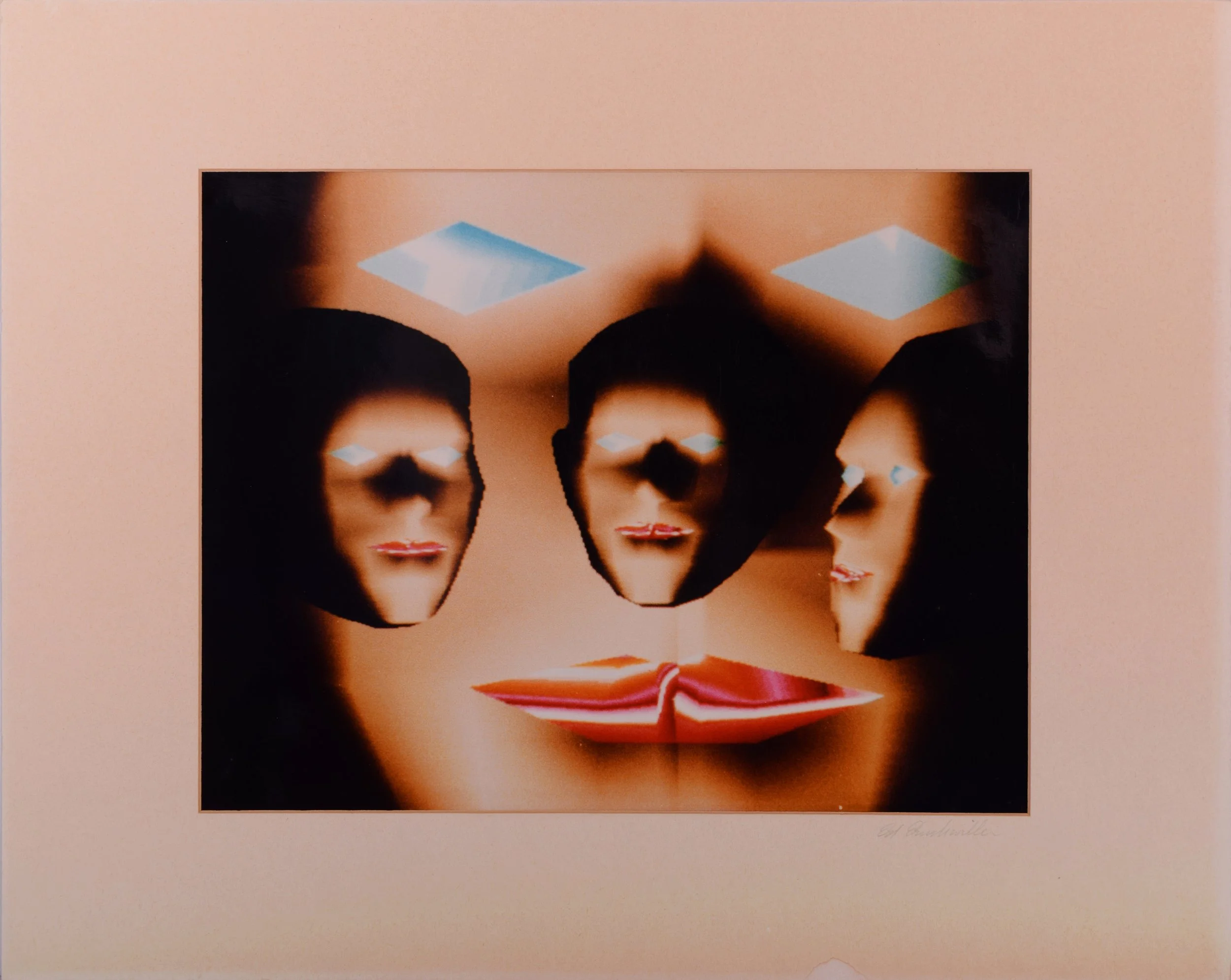
“Untitled,”Ed Emschwiller, computer-generated still-frame, (Movie still) photographic print, 20 x 16, signed by the artist on the mat, framed with glass, price on request
From the Estate of Ilene Schuster
Ed Emshwiller (1925-1990) was a visionary American artist and pioneering independent filmmaker. As an abstract expressionist, Emschwiller studied graphic arts and painting at University of Michigan and L'Ecole des Beaux Arts in Paris. He was perhaps best known as a prolific science-fiction illustrator, frequently signing book cover illustrations with various pseudonyms (“Emsh” or “Ed Emsh” or “Willer” or “Ed Emsler”). A Ford Foundation grant allowed him to pursue his interest in experimental cinema. Emschwiller expanded boundaries of time-based media through the use of computer-generated motion graphics, visual effects and experimental technologies. Emshwiller’s landmark works blurred the relationship of illusion with reality, 2-D with 3-D space, and time with space.
David Becker
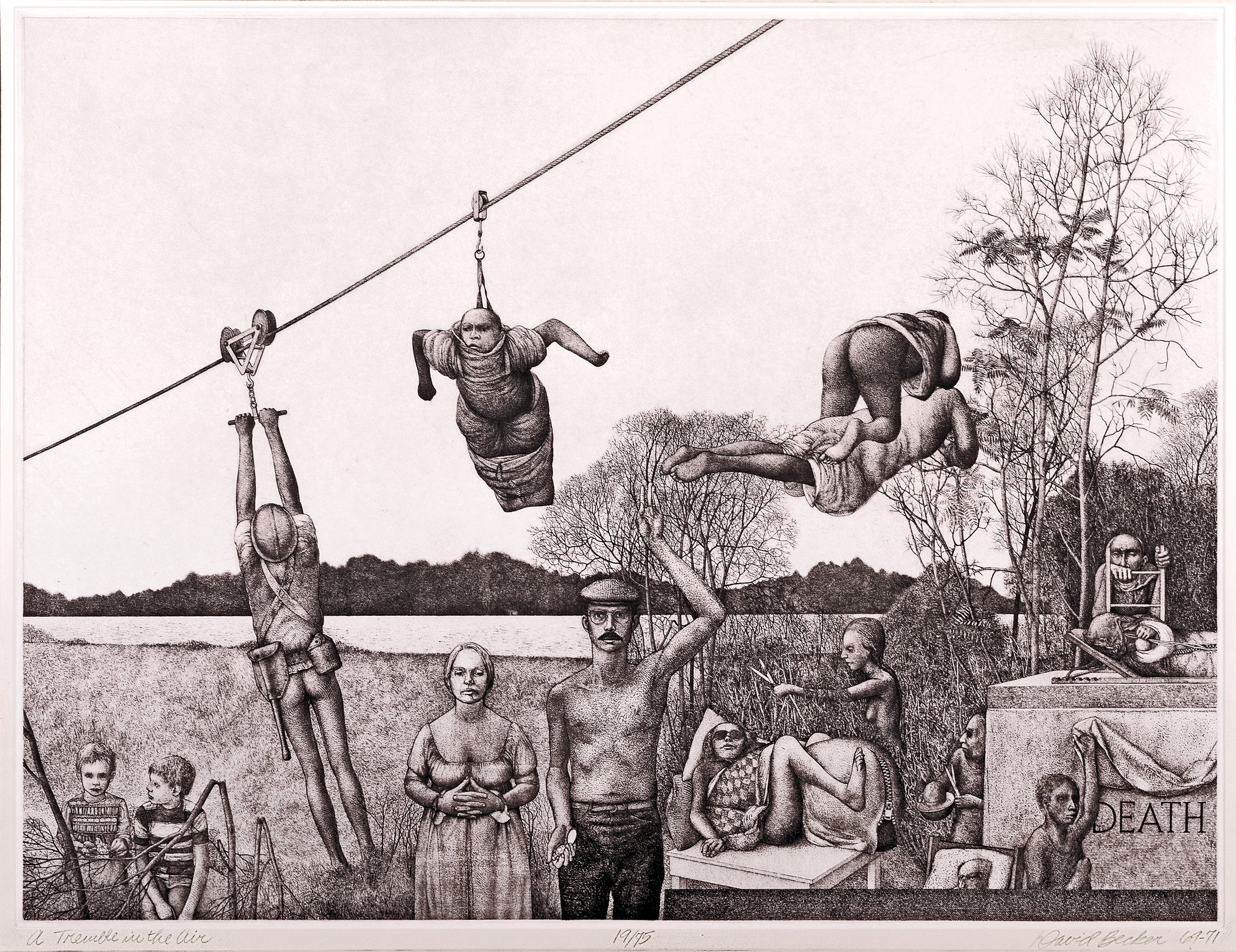
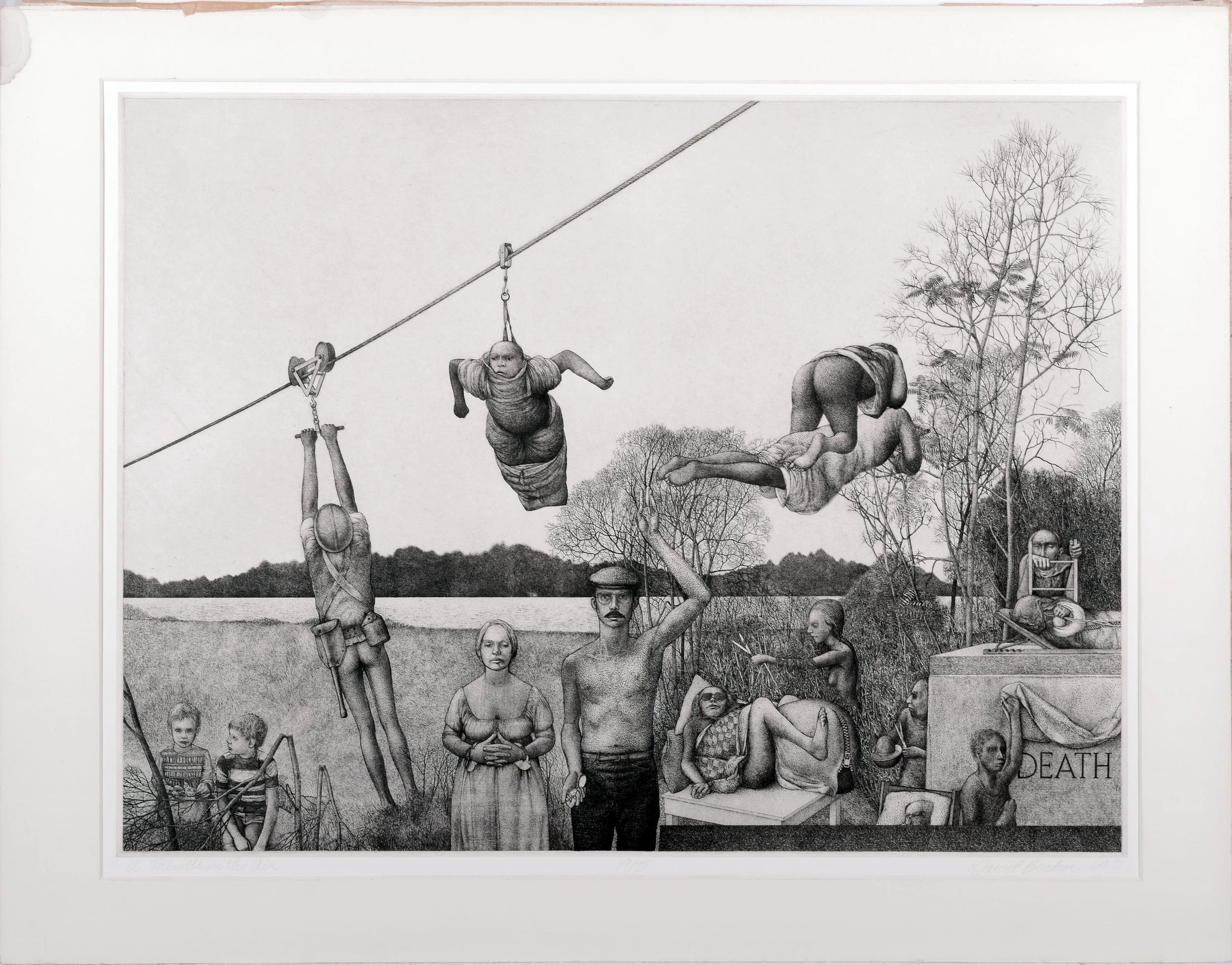
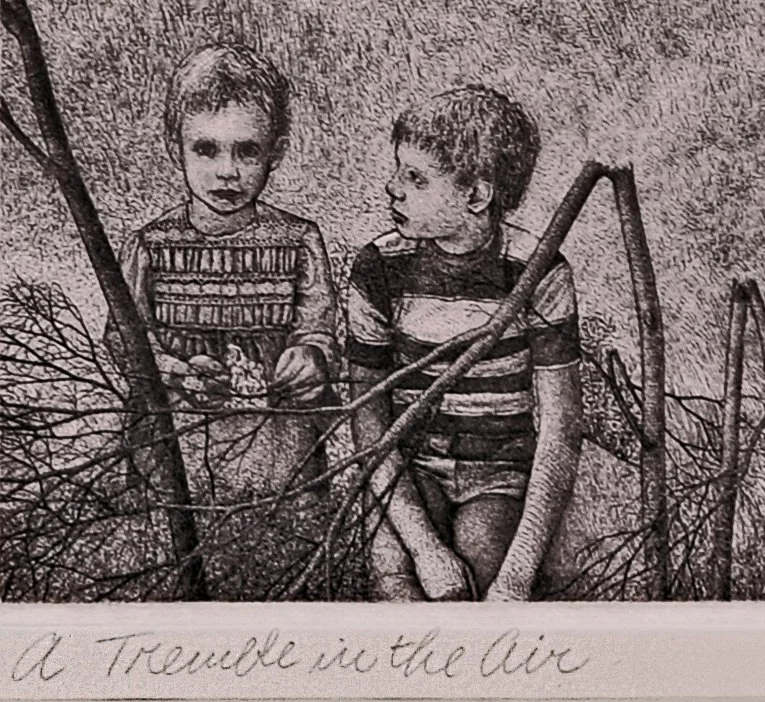
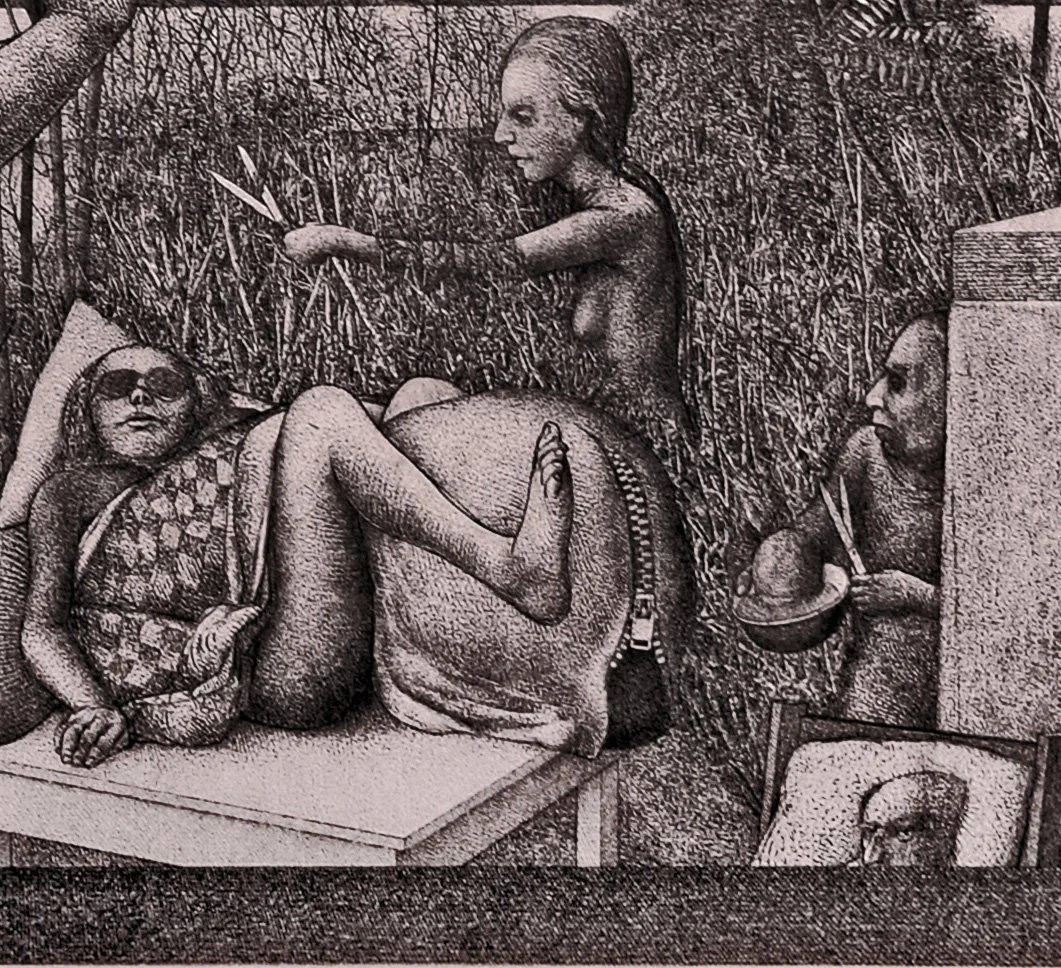
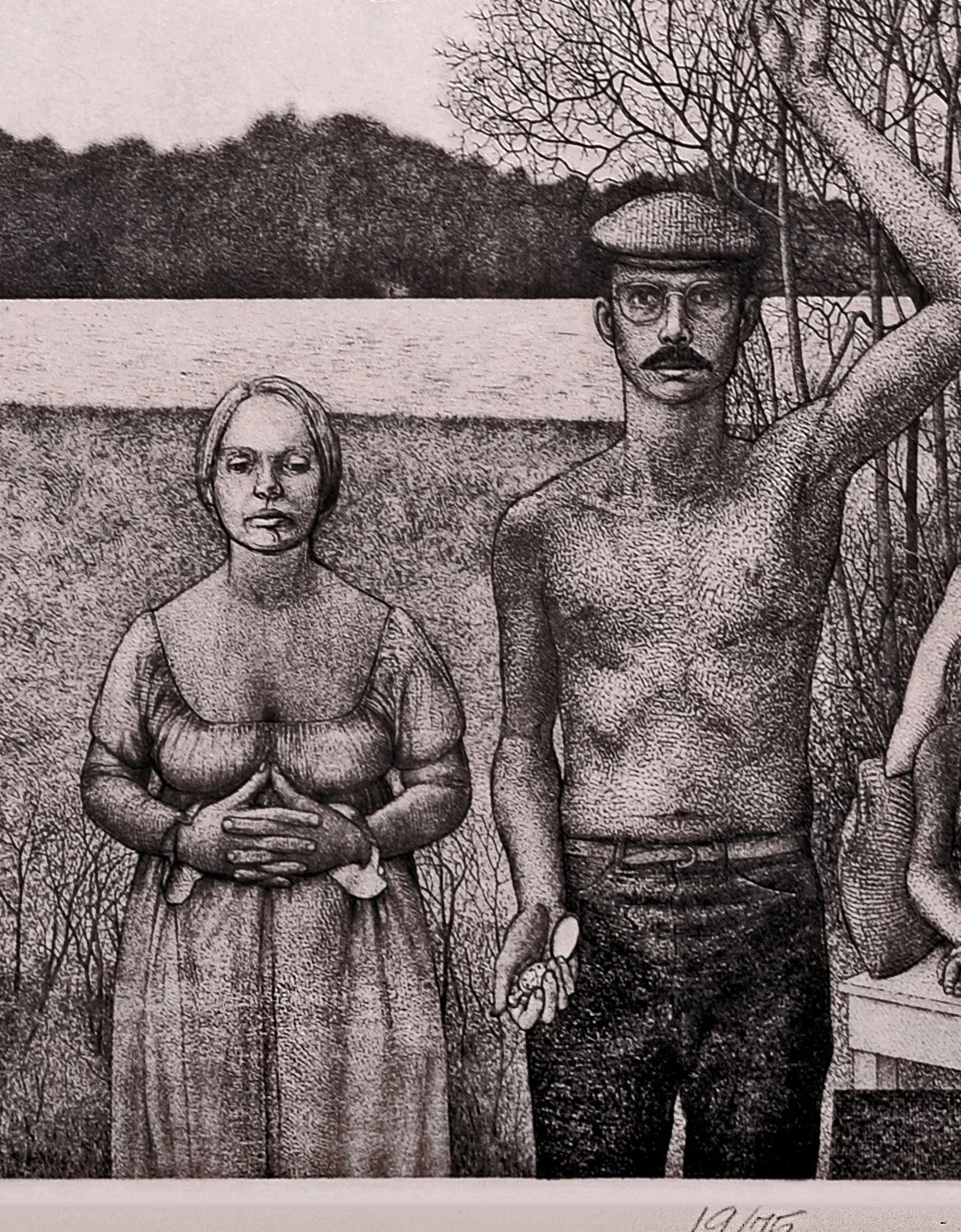
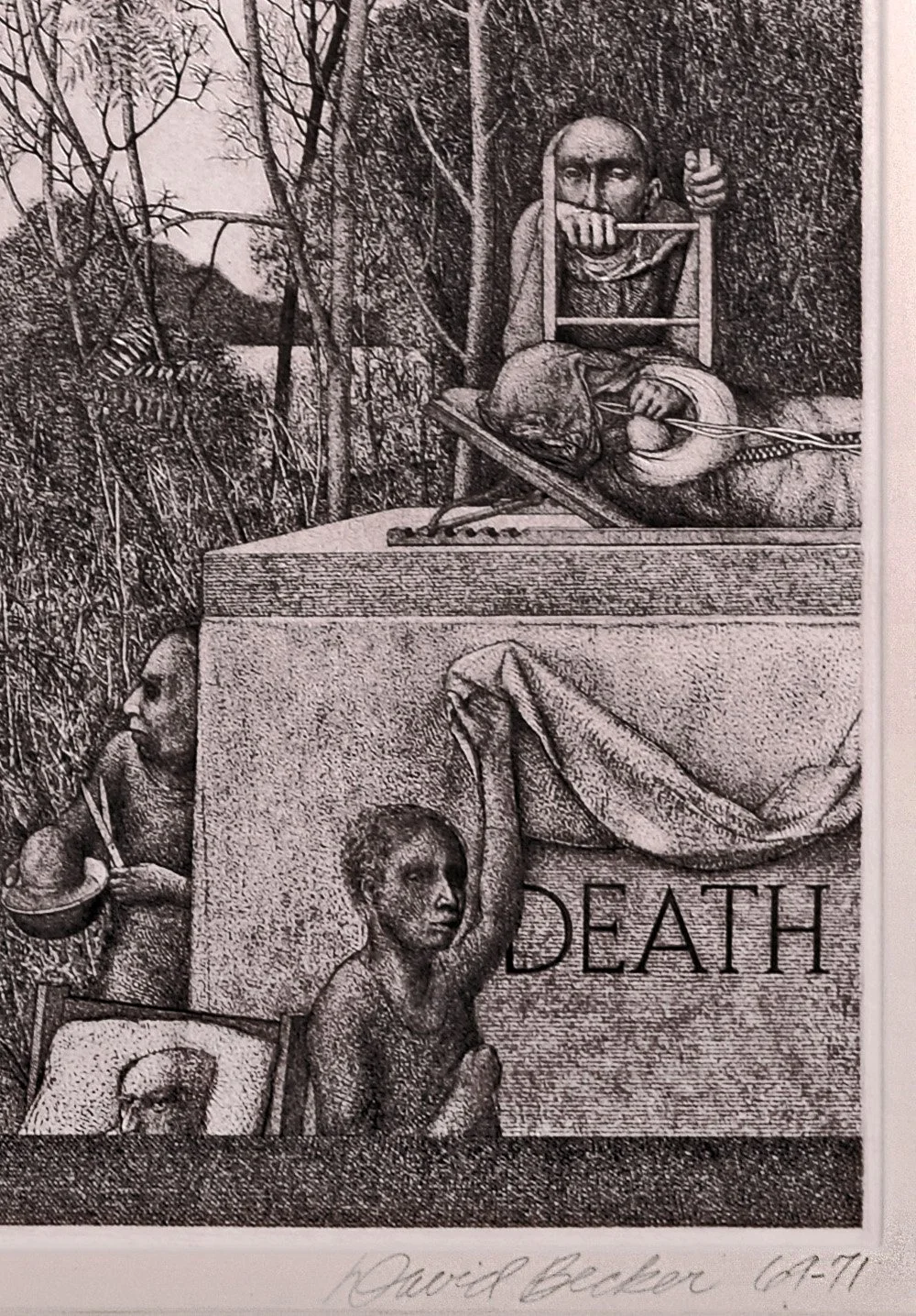
“A Tremble in the Air” David Becker, etching on paper, numbered 19/75, signed David Becker, dated 69-71, lower right. 29 x 22.5”, matted. View: 24 x 18” Some discoloration and small tidemarks on mat, otherwise good condition. $750.00
From the Estate of Ilene Schuster
David Becker (American, b.1937) studied at Milwaukee State teachers college, the Layton School ofArt and the University of Wisconsin-Madison. After two years in the army, he earned his MFA in 1965.Becker taught life drawing at Wayne State University, where he gravitated toward printmaking, and specifically, etching. Becker worked slowly; a plate could take him two years to complete. He is said to have produced only 13 plates. He is the recipient of numerous awards, citations and juried print exhibitions (National Exhibition of Prints, Library of Congress, Gold medal, Museo de Arte Moderno in Columbia, Brooklyn Museum National Print Exhibition, National Academy of Design, British International Print Biennale, National Endowment of the Arts Fellowship) and is represented in the permanent collections of the Brooklyn Museum, the Art Institute of Chicago, the Detroit Institute of Arts Museum, and the Smithsonian Museum of American Art.
The art of David Becker is not for the conformist. His surreal dystopian imagery, allegorical characters, and provocative, dream like imagery has led to his being referred to as the 20th Century Pieter Brueghel. Like a bizarre form of theater, his work creates a mysterious and complex narrative that is as disturbing as it is compelling, and executed with exhaustive descriptivity.
DAVID BECKER :: ARTIST STATEMENT
“What interests me is something that unnerves me… and hopefully it will unnerve the viewer.”
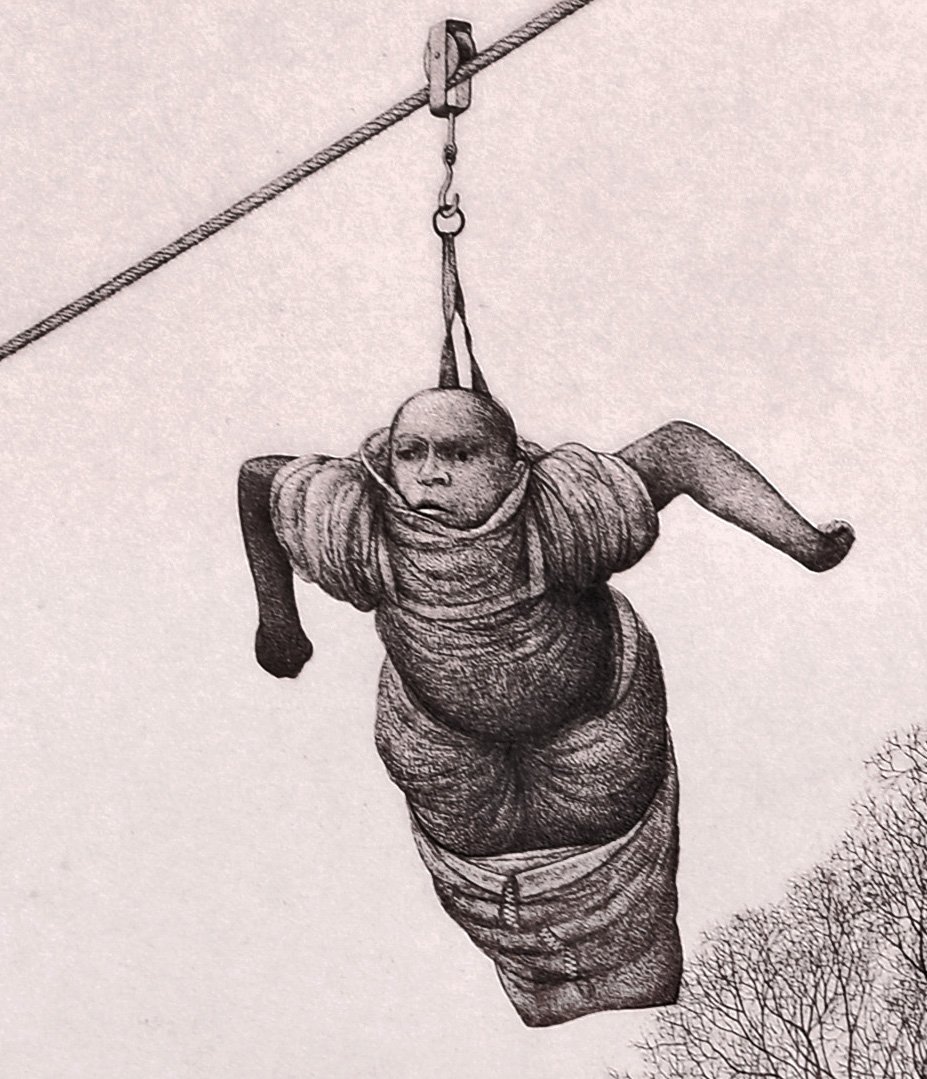
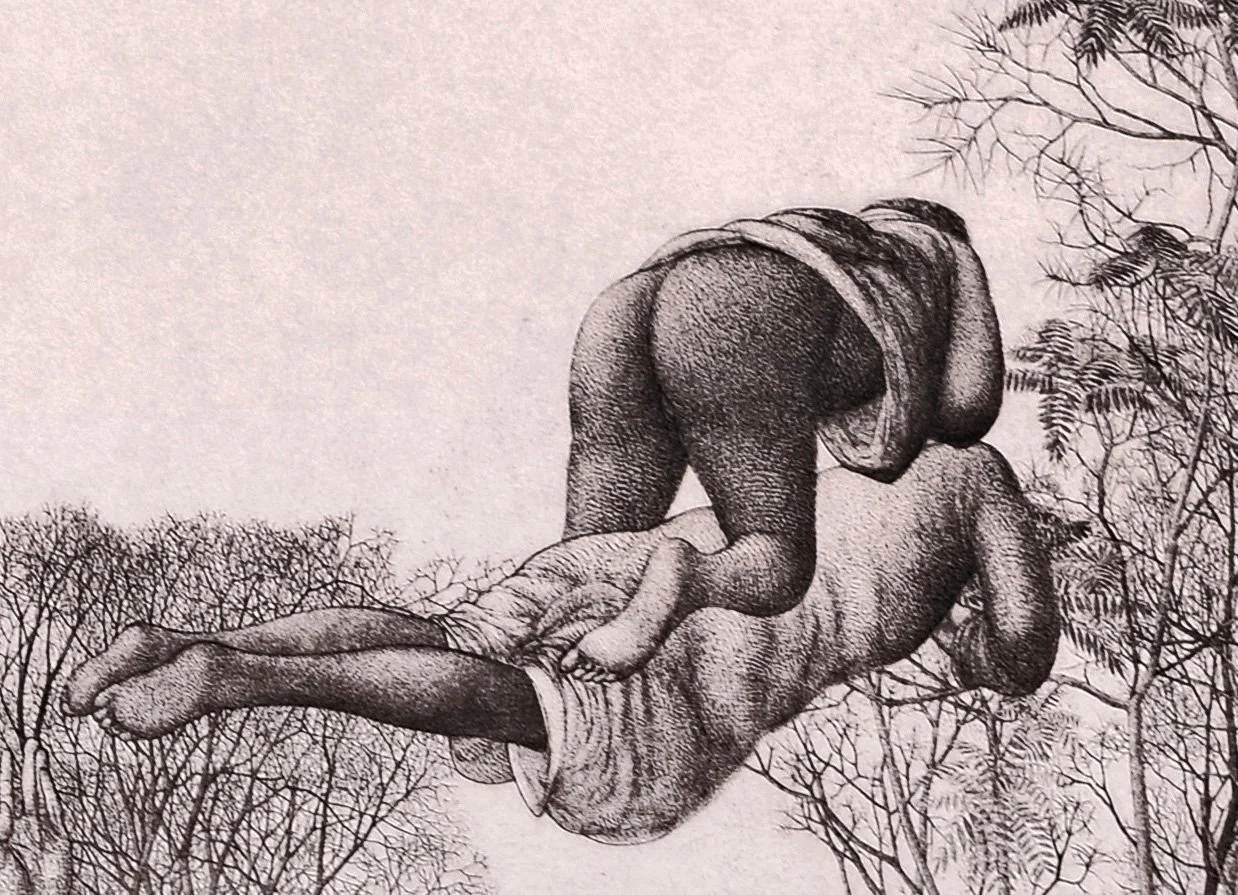
(Click through for enlarged details)
Sue Hirtzel
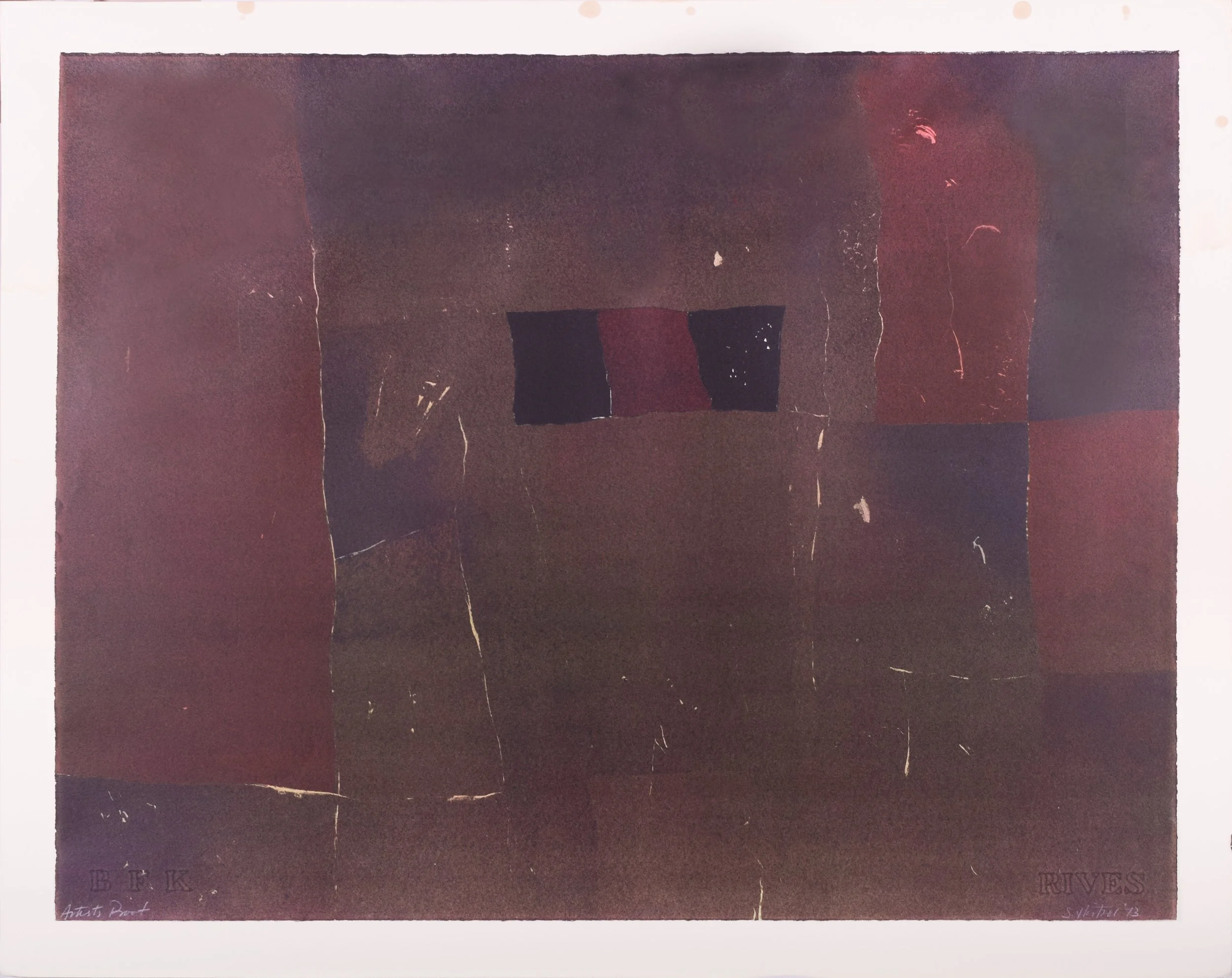
“Notes” 1973, Cliché-Verre, 30 x 23, Artist Proof, $2,000
From the Estate of Ilene Schuster
Sue Hirtzel (1945-2021) Received a BFA from Daemen College and attended the State University of New York, before completing dual Masters degrees (MA and MFA) from Wayne State University, Detroit Michigan.
Hirtzel's work appeared in multiple exhibitions at museums and universities, including the Museum of Fine Arts, Houston, Texas, the Brooklyn Museum, Brooklyn, New York, and the University of Windsor, Ontario, Canada. Her work was widely shown in Michigan and the Midwest, at Cranbrook Art Museum, Bloomfield Hills, Michigan, Kalamazoo Institute of Arts, Kalamazoo, Michigan, and the Art Academy of Cincinnati, Cincinnati, Ohio. Hirtzel was featured in articles for Art Daily and e-flux, and her work is in the permanent collection of Detroit Institute of Arts.
Hirtzel expressed her interest in metaphysical form, ground, space and mark-making. Her imagery is characterized by the interplay of compositional elements and the tensions created by their interaction with space. In this work, “Notes V,” Hirtzel’s subtle, emotionally soothing and meditative use of color evokes mystery and a limitless depth of space.
Hirtzel was known for incorporating non-traditional processes in her art, such as photocopying, computer graphics. She later adopted cliché-verre technique, a hand-drawn process combining light-sensitive photographic material with printmaking. She conducted numerous workshops and conferences, teaching the cliché-verre process, and showed work in the 1980 exhibition "Cliché-verre: Hand-Drawn, Light-Printed" at the Detroit Institute of Arts.
Rosario
(Deceased, no further information about the artist is known,)
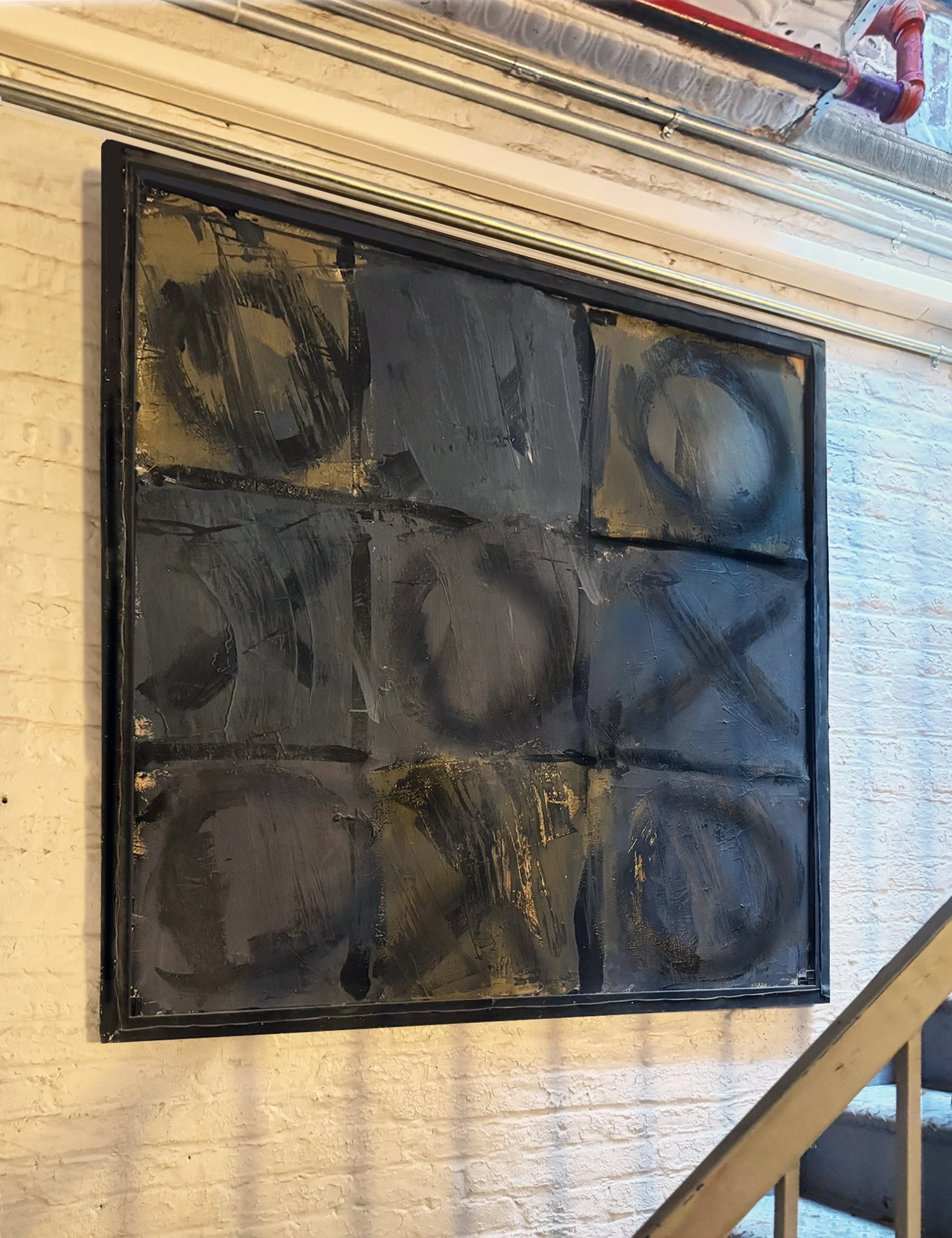
“Tic tac toe” Rosario (d.) Oil on stretched canvas, executed in verso with exposed stretcher bars, 58 x 58
[OA08] price on request
From the Estate of Ilene Schuster
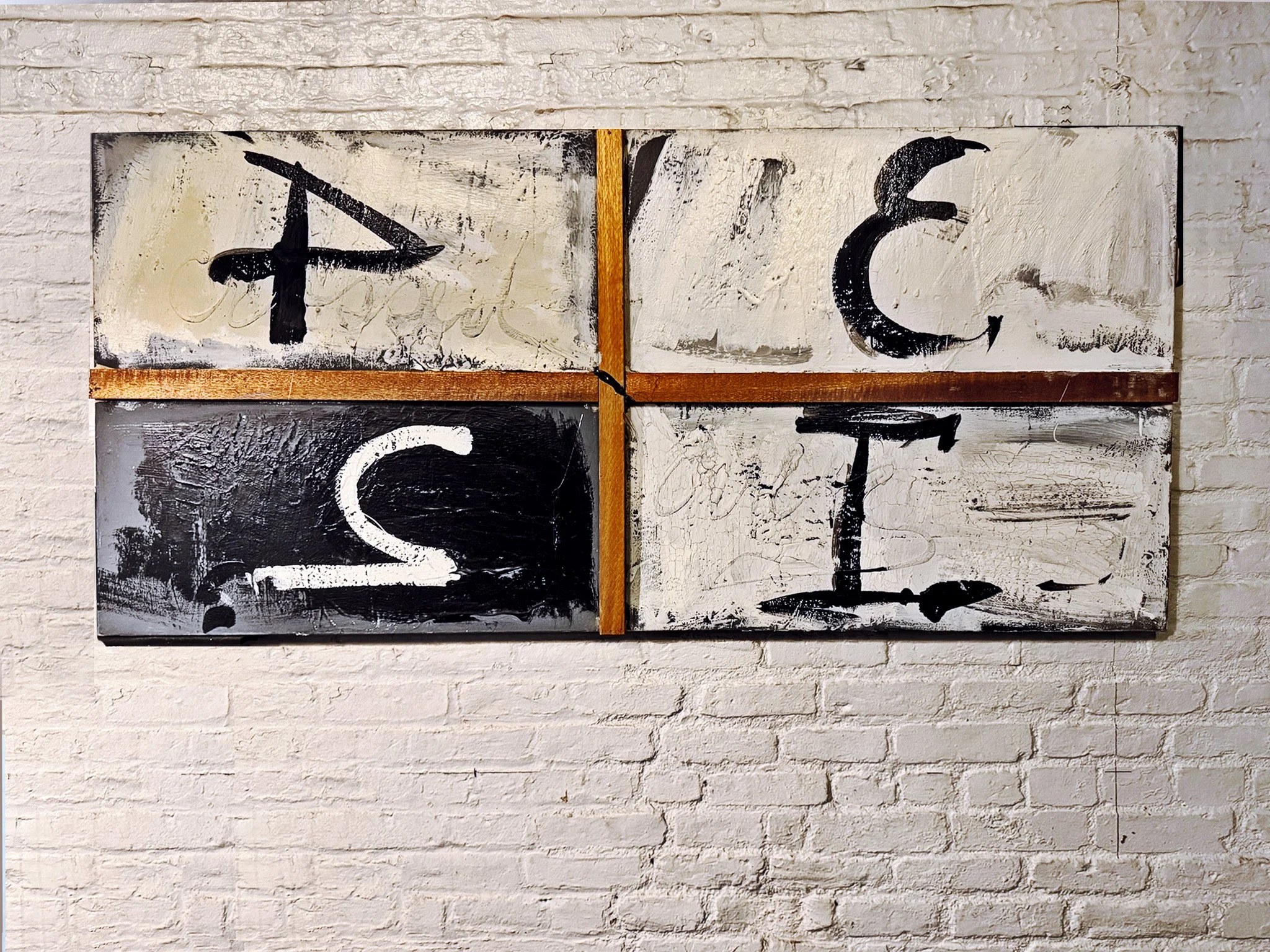
"4, 3, 2, I"Rosario (d.), Oil on board, with applied wood strips, 64 x 30
[OA06] price on request
From the Estate of Ilene Schuster
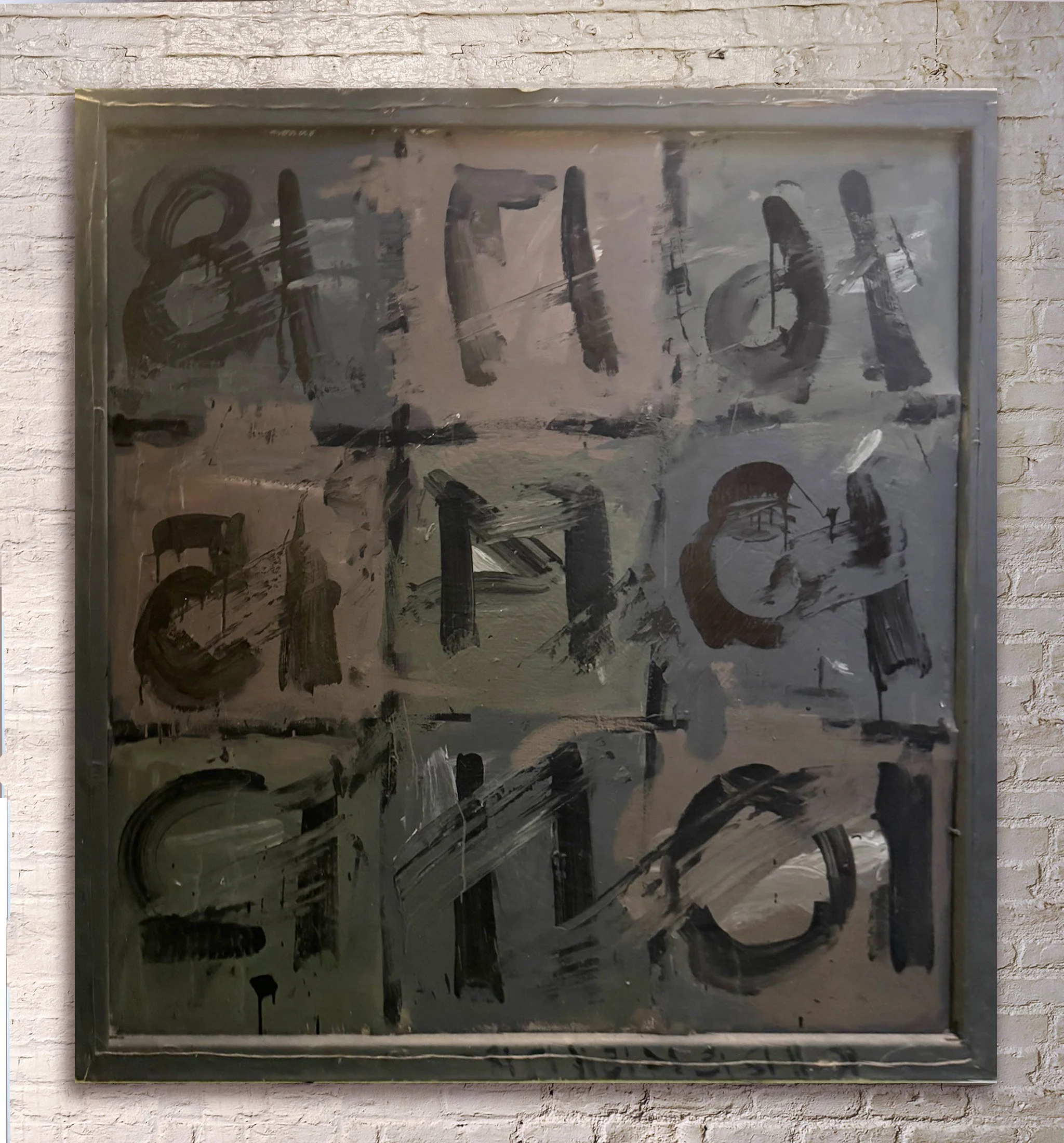
“Countdown from 18 to 10”Rosario (d.) , Oil on stretched canvas, executed in verso, with exposed stretcher bars, 56 x 56
[OA06] price on request
From the Estate of Ilene Schuster
For information or to make an appointment to view the Collection, Contact Hudson EState Sales.